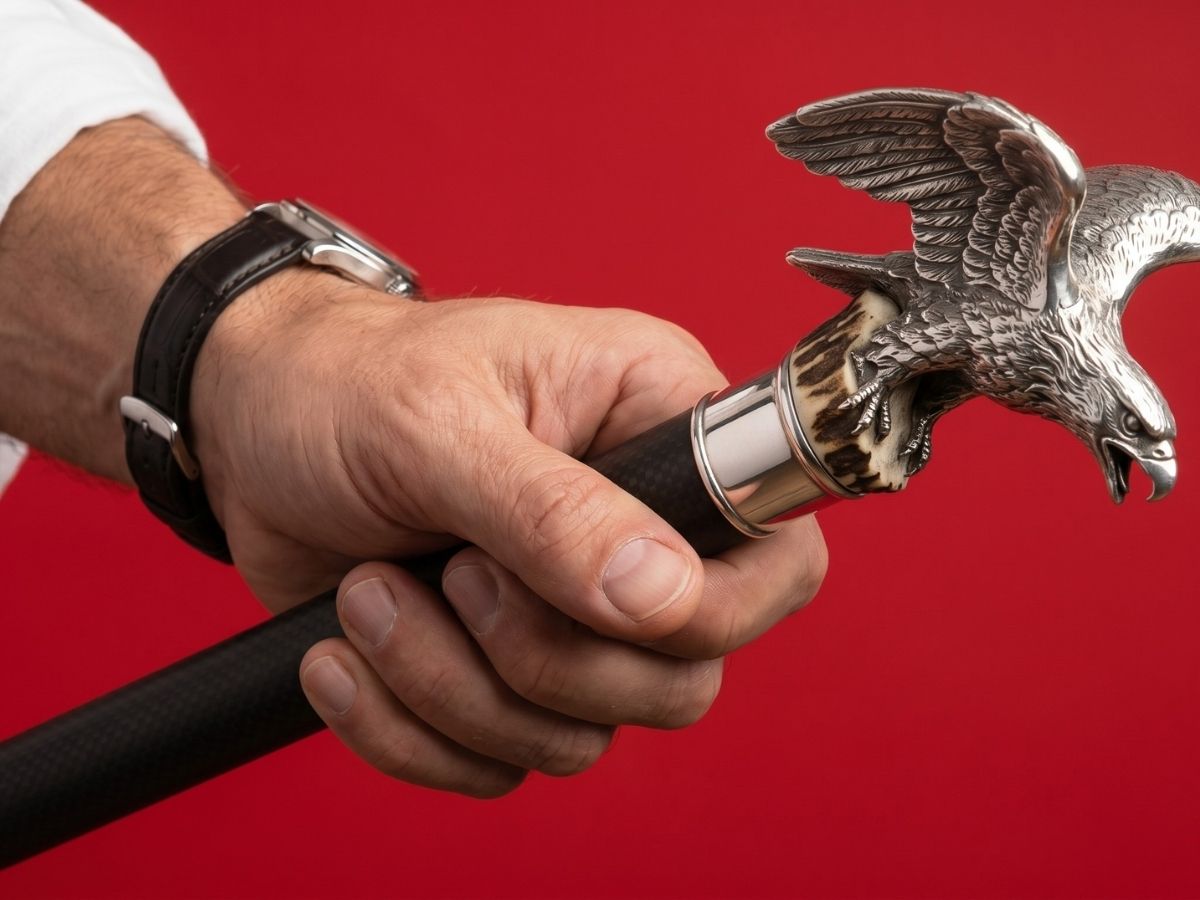
A walking stick is not legally considered a weapon; it can be carried in public with total normality as a mobility aid or, simply, as a symbol of elegance and pleasure. However, it provides reasonable protection against an attack by a person or an animal. With basic and straightforward techniques, it is possible to develop a highly effective defense.
The cane multiplies the strength and precision of our response. Its length provides a greater reach, allowing one to react effectively without the need to apply lethal force. It is a resource that can always be kept at hand, making it the ideal element for anyone seeking to feel protected.
Characteristics of a Defensive Walking Stick
For defensive purposes, a walking stick must have a handle made of metal, wood, deer antler, or another resilient material. The handle should be aesthetic and not bulky,with a medium weight.
Regarding the shaft, the ideal diameter ranges between 18 mm and 21.5 mm,, with a slight taper toward the tip. Materials must be robust, such as noble woods or high-tech composites (carbon fiber, aramid, or Kevlar). Naturally, it should feature its respective metal ferrule. If the tip is covered by a rubber or silicone protector, it is advisable to remove it in a risk situation so that the cane becomes faster and more forceful.
When the shaft has a smaller diameter and is well-balanced, it is handled with greater ease. This allows the tip to be swung with speed and precision; the cane must "feel alive" in the hand. An appropriate weight, within comfort parameters, significantly increases its effectiveness.
How to Grip the Cane for Defense
Normally, the cane is carried in a relaxed manner, held by the handle. However, when moving into a defensive stance, it should be gripped about 10 to 15 centimeters (4 to 6 inches) below the handle (just below the silver collar). This allows for total control of the cane with one hand, optimizing reach and impact force.
The cane can be wielded with one or both hands, using either end or the middle section for blocks, strikes, and shoves. Its greatest virtue lies in the impact: to achieve maximum effect, one should strike with the section from the tip up to the first 12 centimeters (5 inches) of the shaft. The closer the impact is to the tip, the faster one can return to the guard position.
Furthermore, the piercing use of the metal ferrule is an effective technique for maintaining distance, while strikes with the handle are ideal for short-range defense.
Defense Against Human Aggressors
In today’s context, our walking stick can make the difference in an insecure situation. Although the ideal of self-defense is always to evade confrontation,if a response is necessary, being prepared with a cane drastically increases the odds of remaining unharmed.
Strategic Advice:
-
Mobility: Move toward the opponent's side (the side of their stronger arm or where they carry a weapon) and strike firmly. A lateral step will break the attacker's momentum.
-
Targets: The hand is the best target, followed by the wrist, forearm, and elbow. If the opportunity arises, a blow to the knee can momentarily incapacitate the rival.
-
Recovery: Allow the cane to "rebound" after the strike to immediately attack another target.
Categories of Body Targets:
-
Hard: Bones and joints (to strike).
-
Soft: Muscles and sensitive areas (for thrusts or "poking").
-
Extended: Hands and limbs reaching forward. The cane provides an impressive reach advantage against an unarmed attacker or one with a knife.
-
Central: Face, neck, collarbone, or abdomen. This is where a thrust with the tip is most useful for neutralizing a threat quickly and decisively.
Defense Against Animal Attacks
While dogs are formidable companions, they are the animals that most frequently engage in attacks. In these cases, the walking stick acts as an essential barrier.
If the attack is threatening but not imminent, it may be avoided by pointing the shaft at the animal, holding it with both hands as if it were a spear, and issuing a firm shout to intimidate it. Always keep your eyes on the animal. If the dog is defending its territory, retreat slowly without turning your back and never run..
Conclusion
A walking stick is not just an element that assists mobility or a symbol of distinction; it is a faithful ally for our safety. Being prepared and owning a piece of robust, balanced design is the first step to walking with true confidence.